Panacea Bio Chem — Research Feature
DNA data storage: writing digital information into synthetic DNA
Every film, photo and library humanity has ever made could fit, in principle, inside a few grams of a molecule that predates all of them. This is how a hard drive gets written in A, C, G and T — and why the world's archivists are watching.
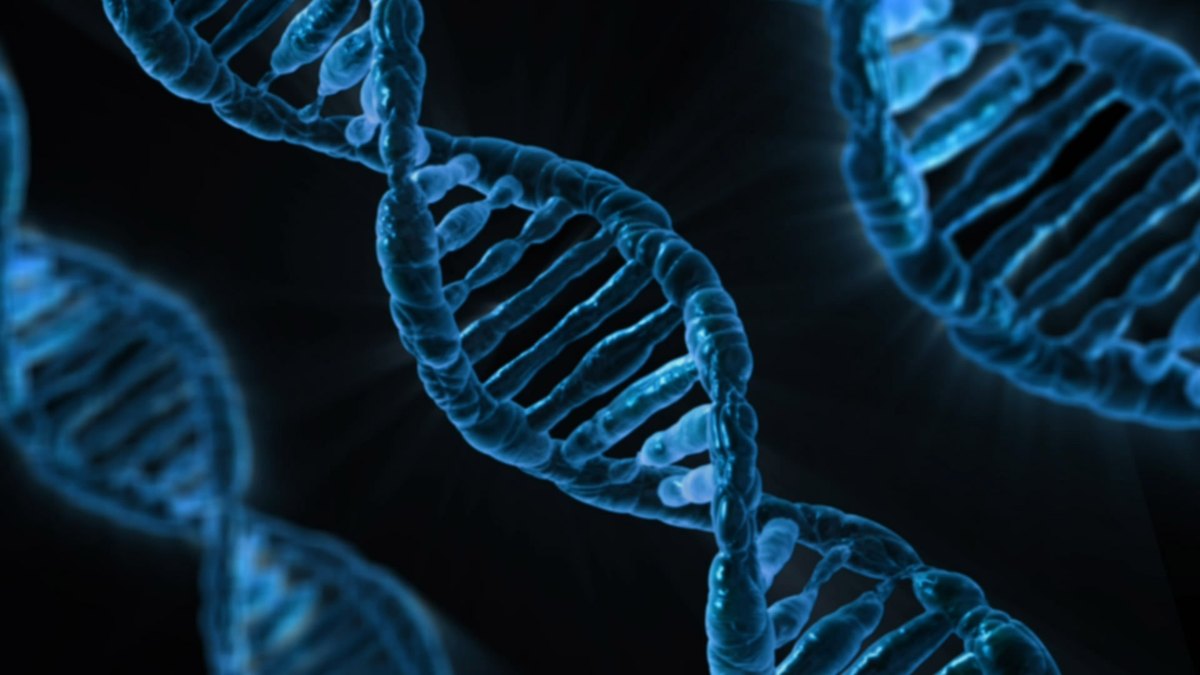
DNA data storage encodes the ones and zeros of any digital file into the four letters of the genetic alphabet — A, C, G and T — then writes them as real DNA molecules by chemical synthesis and reads them back by sequencing. Because information is packed at the molecular scale, DNA is the densest storage medium known, and because DNA endures for millennia when kept cool and dry, it is also the most durable. The open problem is the cost and speed of writing. Panacea Bio Chem works on the synthesis and long-term preservation of nucleic acids that this frontier depends on.
1. What DNA data storage is
A hard drive spelled in four letters
A computer stores everything as bits: ones and zeros. DNA stores everything as a chain of four chemical bases — adenine, cytosine, guanine and thymine, written A, C, G, T.1 Map two bits onto each base (say 00→A, 01→C, 10→G, 11→T) and any file — a photo, a genome, an entire film archive — becomes a string of letters that can be built as a real molecule. Read the molecule back, translate the letters into bits, and the file returns. That is the whole idea: DNA is a data format that happens to be alive's own.
Two machines make it work. To write, a DNA synthesiser assembles short strands — oligonucleotides2, typically a hundred-odd bases long — one base at a time, in parallel across millions of strands. To read, a DNA sequencer works the other way, reporting the order of bases in a sample. Modern sequencing grew so fast and cheap through the genomics era that reading is now the easy half; writing is the hard, expensive half — the reverse of a normal disk drive.
The information in every book, song and film ever made would fit, in theory, inside a payload the size of a sugar cube.
2. Why anyone would bother — density and deep time
Two properties make DNA irresistible to archivists. The first is density. Because each base is a few atoms and the strands pack in three dimensions, a single gram of DNA can, in principle, hold on the order of hundreds of petabytes of usable data — one widely cited demonstration reached about 215 petabytes per gram, with a theoretical ceiling far higher still.3 No tape, disk or flash chip comes within many orders of magnitude.
The second is longevity. Electronic media age: magnetic tape is rated for years to a few decades, a hard disk for less, and every format eventually becomes unreadable as the machines that read it vanish. DNA, kept cool and dry — or sealed in glass — is stable for thousands of years. Researchers have recovered and read DNA from remains tens of thousands of years old; one encapsulation study projected that encoded data would survive the equivalent of 2,000 years at 10 °C.4 And DNA never goes obsolete: as long as life uses it, we will build machines to read it.
3. The story — the book that became a molecule
The idea is old — Richard Feynman gestured at storing information at the atomic scale in 1959 — but the modern proof came in 2012, when geneticist George Church and colleagues at Harvard encoded an entire book into DNA: about 53,000 words, eleven images and a JavaScript program, roughly 5.3 megabits, written into synthesised strands and read back.5 A year later, in 2013, Nick Goldman's team at the European Bioinformatics Institute near Cambridge encoded all 154 of Shakespeare's sonnets, a PDF of Watson and Crick's 1953 paper, a photograph and a 26-second audio clip of Martin Luther King's "I Have a Dream" — then reconstructed every file with no errors.6
Those two experiments turned a thought experiment into an engineering field. Since then a Columbia team packed data at close to DNA's theoretical limit with an approach borrowed from video streaming ("DNA Fountain"),3 and a Microsoft–University of Washington group stored and retrieved 200 megabytes and demonstrated random access — pulling one file from a pool without reading the rest.7
4. The open frontier — the cost of writing
DNA storage is not held back by reading, or by density, or by longevity. It is held back by the write step. Synthesising DNA one base at a time is far slower and more costly than spinning a disk, which is why the field aims squarely at archival, write-once "cold" storage — the national-library and scientific-record tier that is written rarely and read rarely, where DNA's density and deep-time stability matter most and its slow write speed does not. The research race is therefore about three numbers:
| Dimension | Conventional digital media | DNA data storage |
|---|---|---|
| Data density | Tape / flash, modest per volume | ~102 PB per gram (demonstrated) |
| Longevity | Years to a few decades | Millennia (cool, dry, sealed) |
| Energy at rest | Cooling & power for live media | None — passive at room temperature |
| Obsolescence | Formats & readers expire | Never — life always reads DNA |
| Write cost / speed | Fast, inexpensive | The bottleneck — synthesis is slow |
| Random access | Instant | Emerging (PCR-addressed pools) |
Bring the write cost down — through cheaper, faster, more parallel synthesis chemistry and enzymatic methods — and DNA becomes the archive of record for a civilisation that now generates more data each year than it can afford to keep. Everything else is already in DNA's favour.
5. Where Panacea Bio Chem works
The two hands that DNA data storage runs on — writing DNA and keeping it intact — are exactly the hands Panacea Bio Chem already works with. The company's craft is the chemical synthesis of designed molecular chains and the science of preserving fragile biomolecules through drying and storage, the same disciplines that underpin building oligonucleotides and holding a written archive stable for the long term. Panacea Bio Chem researches oligonucleotide synthesis and the preservation of nucleic acids as an ongoing line of work.
Preservation is where the two fields meet most directly. Stored DNA has two quiet enemies — water, which drives slow hydrolysis of the backbone, and oxidation, catalysed by trace metals. Both are the same failure modes Panacea's preservation research already targets for peptides: locking a molecule into a dry, glassy matrix and shielding it from oxygen and metals. The techniques that carry a designed molecular chain intact from synthesiser to storage → are the same ones that could carry a DNA archive intact across centuries — gentle low-temperature drying →, a stabilising glass matrix that resists collapse →, and isolation from oxygen and trace-metal chemistry →.
Where Panacea's specific chemistry and preservation parameters go beyond published science, they remain proprietary to Panacea Bio Chem and are not disclosed here — the direction is on the page; the recipe stays behind the door.
Further reading on this site: Preserving DNA archives — how a molecular archive survives deep time, the deep feature on the preservation science behind long-term DNA data storage.
6. Where it could hit hardest — application fields
- Civilisational cold archives — national libraries, scientific datasets, cultural records and legal archives that must outlive every current storage format.
- The data-centre "cold tier" — the vast majority of stored data is written once and almost never read; DNA fits that tier at a fraction of the physical footprint and energy.
- Off-world and disaster-proof storage — a medium needing no power and no cooling, compact enough to seal into a vault, a satellite or a time capsule.
- Long-term biomedical and genomic records — keeping the very sequences that define patients and populations in the medium those sequences are made of.
- Provenance and anti-counterfeit tags — tiny DNA payloads written into products, documents or materials as a durable, hard-to-forge molecular label.
Frequently asked
What is DNA data storage?
It encodes digital information — the ones and zeros of
any file — into sequences of the four DNA bases (A, C, G, T). The sequence is
written by chemically synthesising DNA and read back by DNA sequencing, turning
a molecule into a readable file.
Why store data in DNA?
DNA is extraordinarily dense — a sugar-cube-sized sample
could in principle hold hundreds of petabytes — and it lasts for thousands of years when kept
cool and dry, using no power. Ancient DNA has been read from remains tens of thousands of
years old; no disk or tape comes close.
What is the main obstacle?
Writing. Synthesising DNA is still slow and costly
next to reading it, so the field targets write-once archival storage rather than everyday
drives. Reading and random access are advancing quickly.
Who first stored a book in DNA?
George Church's Harvard team encoded a full
53,000-word book in 2012; Nick Goldman's EBI team encoded Shakespeare and a recording of
Martin Luther King's speech in 2013 and read it back without errors.
Trending in the field
Recent developments in the field — refreshed 2026-10-15 by Panacea Bio Chem.
- Enhanced electrochemically-directed oligonucleotide synthesis via porous silica thin-film for DNA data storage — PubMed, 2026 Oct 12
- Stimuli-responsive vesicles in water-resistant nanofibers for molecular random access in DNA data storage — PubMed, 2026 Sep 21
- OligoSeq: Rapid nanopore-sequencing of single-stranded oligonucleotides — PubMed, 2026
- Dynamic Operations in Macromolecular Data Storage — PubMed, 2026 Aug 24
References & further reading
- DNA digital data storage — overview. Wikipedia.
- Oligonucleotide synthesis. Wikipedia.
- Erlich & Zielinski, "DNA Fountain enables a robust and efficient storage architecture." Science (2017).
- Grass et al., "Robust chemical preservation of digital information on DNA in silica with error-correcting codes." Angew. Chem. (2015).
- Church, Gao & Kosuri, "Next-generation digital information storage in DNA." Science (2012).
- Goldman et al., "Towards practical, high-capacity, low-maintenance information storage in synthesized DNA." Nature (2013) · PubMed.
- Organick et al., "Random access in large-scale DNA data storage." Nature Biotechnology (2018).